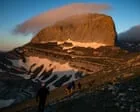
More than four decades have elapsed since Evangelos Geroliolios made his first ascent to the home of the ancient gods. At the top of Mount Olympus, on the rocky peak of Greece’s highest mountain, he felt unalloyed awe. “I’ve never forgotten that unique moment, that unique feeling up there on the throne of Zeus,” recalled Geroliolios, who as mayor of Dion-Olympus now spends a great deal of his time administering the area around the site.
Described by Homer as the “seat of the immortals”, its craggy summit – where Zeus, the father of the gods, is said to have held court – rises 2,918 metres above the sea. “You get this incredible sense of place, fused by myth, beauty and the weight of history – all of which we want to share and hope will be recognised internationally,” he said. Greek officials have long lobbied for Mount Olympus to be included on the Unesco list of world heritage sites; soon champions of the cause will learn if the site will finally be granted the coveted designation.
The World Heritage Committee is scheduled to begin discussing the nomination on Sunday at its 48th session, now under way in Busan, South Korea. The annual meeting ends on 29 July. Greece first proposed the mountain’s inclusion on the list of places considered by Unesco to be “of outstanding value to humanity” in 2014, citing both its cultural and environmental significance.
The area was declared as Greece’s first national forest in 1938, in tribute to the uniqueness of terrain covered not only by verdant forest but alpine fields, gorges, ravines and springs, all within close proximity of the sea. Litochoro, the nearest town to the mountain, lies three miles (5km) away from breathtaking beaches practically at the foot of the mountain. In recognition of its abundance of flora and fauna, Unesco designated Olympus a biosphere reserve in 1981.
Further environmental protection came in the form of a presidential decree, when the mountain was declared a national park, in 2021. “But,” says Geroliolios, “becoming a world heritage site would not only be important for Greeks. It would speak to the entire planet.
Olympus is up there with the Parthenon and it’s vital that we safeguard this environment of myth and history. For us, protection is the alpha and omega.” Last year, the committee inscribed 26 new properties on Unesco’s World Heritage list, bringing the total number of sites to 1,428 across 170 countries. Of the 21 in Greece, only two have been inducted as mixed cultural and natural world heritage sites.
Under an international treaty overseen by Unesco, the treasures, which include landmarks such as the Great Wall of China, the Egyptian Pyramids and the Taj Mahal, automatically become protected zones. Increasingly the designation is regarded as a bulwark against the depredations of development and overtourism. Like much of Greece, the mountain’s popularity has soared over the past decade, with about 500,000 visitors recorded last year.
It is a number that is widely predicted to rise on the back of revived interest in the ancient world after the 17 July release of Christopher Nolan’s The Odyssey. The record-breaking blockbuster, inspired by Homer’s epic, was partially filmed in Greece, which also helped subsidise the movie.






Comentários (0)
Entre ou cadastre-se para comentar.